
Behind the Numbers: Mapping Filipino Voter Awareness and Education
The Challenge
In the Philippines, not all voters enter the ballot box with equal knowledge. Socioeconomic disparities, digital divides, geographic isolation, and varying levels of civic literacy create significant barriers to informed democratic participation. This capstone project tackles a critical question: How can we ensure that every Filipino voter—regardless of location, age, or economic status—has access to credible election information through data-driven education strategies?
Our Approach
Using a modern data architecture, we integrated and analyzed multiple datasets spanning voter registration, demographics, digital connectivity, and socioeconomic indicators to map voter awareness gaps across the Philippines. Our analytical pipeline—built with dlt for data ingestion, dbt for transformation, and Tableau for visualization—processed data from COMELEC's voter registry, PSA census records, and geospatial sources to uncover patterns that traditional methods might miss.
Measuring Voter Awareness
We developed a composite awareness index based on four key indicators:
Higher Education Attainment – Proxy for civic literacy and information processing capacity
Internet Access – Gateway to digital election information and fact-checking resources
Social Media Usage – Primary channel for political engagement among Filipino voters
Youth Population Share – Indicator of digital nativity and engagement patterns
This multidimensional approach allowed us to move beyond simple assumptions and quantify awareness readiness across all 1,628 cities in the Philippines.
Key Findings
Our analysis revealed three critical insights:
Youth-Driven Demographics: Millennials and Gen Z collectively represent over 60% of eligible voters, making them the dominant force in Philippine elections—yet their engagement varies dramatically by location.
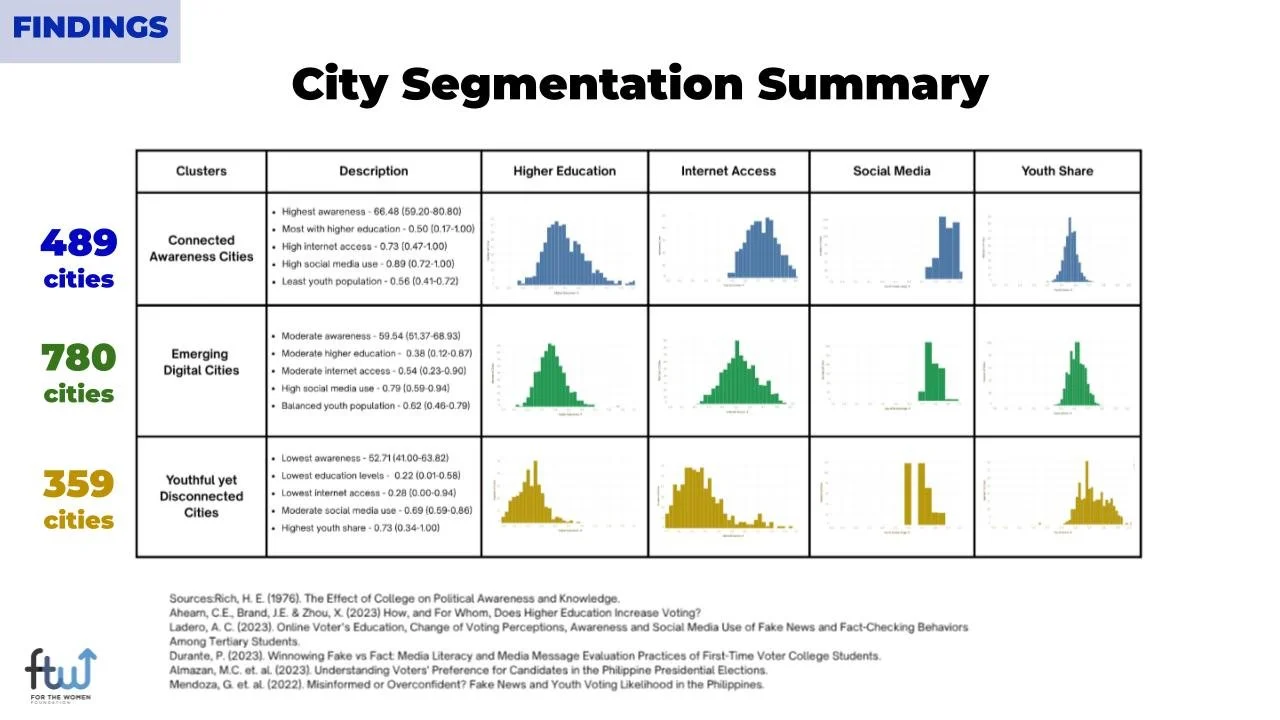
Three Distinct Voter Segments Emerged across 1,628 cities:
Youthful yet Disconnected Cities (359 cities) – Concentrated in Mindanao (BARMM, Regions 9, 11, and 12), these areas have the highest proportion of 18-24 year-olds but face significant barriers: predominantly elementary-level education with notable shares having no formal schooling, limited internet access, and low digital engagement create a perfect storm of vulnerability to misinformation. Population profile: Mostly millennials, married, with minimal educational access.
Emerging Digital Cities (780 cities) – The largest segment, representing middle Philippines. Developing awareness through growing online engagement and gradually improving infrastructure. Population profile: Mostly millennials, married, reached elementary or high school level.
Connected Awareness Cities (489 cities) – Urban centers with high education levels (high school and above) and robust digital access, where voters are best-positioned to access credible information. Population profile: Mostly millennials, married, with stronger educational foundations.
Participation Gap: Despite 75% voter turnout in 2022, the remaining 25% of voting-age Filipinos—millions of potential voters—remained disengaged, with concentration in underserved segments.
Geographic Concentration of Vulnerability
The mapping exercise revealed stark regional disparities. "Youthful yet Disconnected Cities" cluster heavily in Mindanao, particularly in BARMM, Region 9 (Zamboanga Peninsula), Region 11 (Davao), and Region 12 (SOCCSKSARGEN). This geographic concentration suggests that voter education resources must be strategically deployed to regions where the need is most acute.
Impact & Recommendations
This research provides actionable intelligence for election administrators, civil society organizations like NAMFREL, and government agencies including COMELEC and DILG. Our data-driven strategy enables:
Targeted Resource Allocation: Prioritize voter education initiatives in "Youthful yet Disconnected Cities" (359 cities in Mindanao) where the need is greatest
Segment-Specific Messaging: Develop tailored awareness campaigns for each of the three voter profiles, maximizing relevance while optimizing costs across all 1,628 cities
Evidence-Based Planning: Ground election education strategies in empirical data rather than assumptions, using our four-indicator awareness framework
Why This Matters
Democratic legitimacy depends on informed participation. When young, rural, and low-income voters lack access to accurate election information, our democracy suffers. This project demonstrates how data science can strengthen civic infrastructure—not by replacing human judgment, but by illuminating where our collective efforts are most urgently needed.
By identifying the most vulnerable voter segments and mapping their geographic distribution, we've created a roadmap for fairer election education that can help ensure every Filipino voter can cast their ballot with confidence and knowledge.