
Uneven Progress: Why 4Ps Works Differently Across the Philippines
The Challenge
The Pantawid Pamilyang Pilipino Program (4Ps) stands as one of the Philippines' most ambitious social interventions—a conditional cash transfer program designed to break the intergenerational cycle of poverty by supporting health, nutrition, and education for the poorest Filipino families. Since its launch, 4Ps has reached millions of beneficiaries and contributed to measurable poverty reduction nationwide.
Yet beneath the national success story lies a troubling reality: 4Ps impact is deeply uneven across regions. Some areas show strong improvements in health outcomes, school enrollment, and family welfare. Others continue to struggle despite having large numbers of beneficiaries and significant program investment.
The core question isn't whether 4Ps works—it's why the same program produces such different results depending on where families live. A beneficiary family in one region may experience transformative improvements, while a similar family elsewhere sees minimal change. This geographic disparity suggests that 4Ps alone is not enough—it must be complemented by region-specific interventions that address local barriers.
This capstone project asks: How can we identify which regions struggle most across critical 4Ps outcome areas, and what targeted, region-specific interventions can complement the program to improve its impact?
Our Approach: Regional Diagnostic Framework
Our Batch 11 capstone group built a comprehensive regional diagnostic system that goes beyond simple beneficiary counts to assess actual program outcomes across four critical dimensions. By integrating data from PSA surveys, DSWD quarterly reports, and DepEd enrollment statistics, we created a multi-dimensional view of where 4Ps is succeeding—and where it's falling short.
The Four-Pillar Outcome Framework
We analyzed regional performance across the core objectives of 4Ps:
1. Health and Nutrition
Immunization rates among 4Ps children (National Demographic and Health Survey 2022)
Prenatal and postnatal visit compliance among pregnant 4Ps members
Comparison against WHO-UNICEF national benchmarks
2. Education
Net enrollment rates by region and grade level (DepEd 2019-2020)
School participation patterns among 4Ps beneficiary children
Regional disparities in educational access
3. Child Labor Prevention
Number and proportion of working children aged 5-17 (PSA Labor Force Survey 2018-2023)
Sectoral distribution of child labor (agriculture, services, etc.)
Correlation with poverty incidence and 4Ps coverage
4. Community Participation
Family Development Session (FDS) attendance compliance rates (DSWD 2024 Q3)
Regional adherence to the 95% FDS attendance target
Engagement patterns among high-beneficiary regions
By mapping regional performance across all four dimensions simultaneously, we can identify critical focus areas—regions that consistently underperform despite adequate 4Ps coverage, indicating that systemic barriers require targeted interventions beyond cash transfers.
Technical Architecture
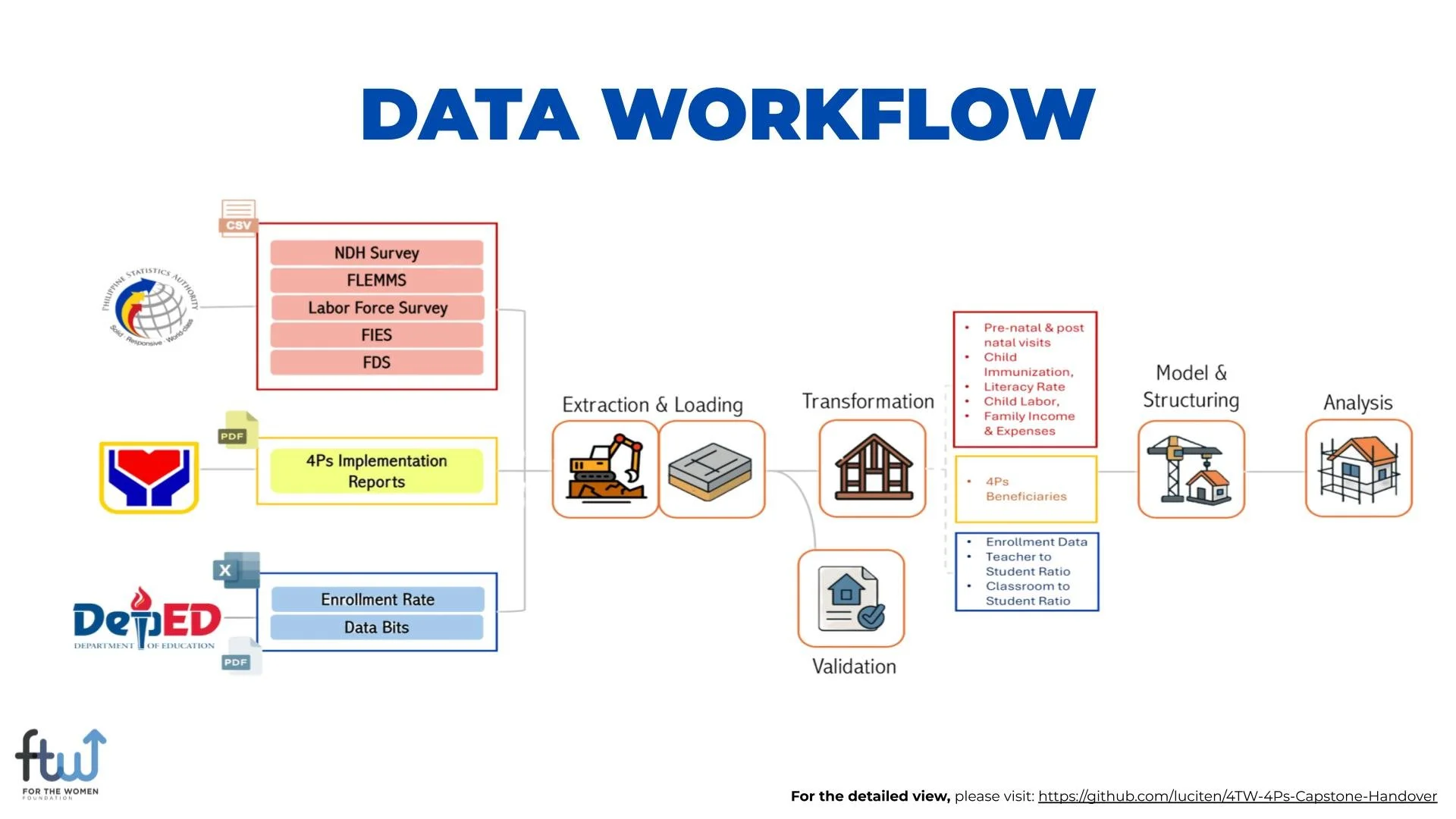
Our modern data engineering pipeline integrated diverse government datasets:
Data Collection & Ingestion
Python scripts for automated data collection from PSA, DSWD, and DepEd sources
PDF scraping for quarterly implementation reports
CSV and XLSX file processing across multiple years (2018-2024)
Temporal alignment of datasets with different reporting periods
Storage & Transformation
ClickHouse cloud data warehouse for centralized storage
dbt (data build tool) for creating structured, analysis-ready tables
Data quality checks ensuring consistency across regional codes
Google Sheets integration via App Script for analyst accessibility
Analytics & Visualization
Four-quadrant analysis framework plotting performance vs. beneficiary coverage
Median-based benchmarking to identify regional outliers
Interactive visualizations showing critical focus areas
Evidence-based recommendation matrix by region
This reproducible pipeline can be updated quarterly as new DSWD implementation reports and PSA survey data become available, creating a living diagnostic system for 4Ps program management.
Key Findings
Our analysis revealed persistent patterns of regional disparity that challenge the one-size-fits-all approach to poverty reduction:
1. Health and Nutrition: BARMM and Neighboring Regions Face Critical Gaps
Immunization Crisis:
National context: WHO-UNICEF reported 66% routine vaccine coverage in 2022
4Ps reality: Immunization rate among 4Ps children remains below 35%—less than half the national average
Critical focus areas: BARMM and surrounding regions show the lowest immunization compliance despite significant 4Ps beneficiary populations
Prenatal Care Disconnect:
National benchmark: 83% of Filipino women received at least four antenatal care (ANC) visits (NDHS 2022)
4Ps performance: Only 32.42% of pregnant 4Ps members attended prenatal visits
Geographic concentration: BARMM and nearby regions consistently appear in the lowest-performing quadrant
This pattern reveals a fundamental disconnect: 4Ps provides cash transfers conditional on health compliance, yet beneficiary families in certain regions cannot or do not access these services. Cash alone doesn't overcome barriers like facility distance, conflict-affected areas, cultural practices, or lack of healthcare infrastructure.
2. Education: BARMM's Persistent Enrollment Gap
The Enrollment Divide:
Most regions cluster in the 70-80% net enrollment rate range
BARMM falls significantly behind all other regions
Even regions with high 4Ps coverage show varying enrollment rates, suggesting cash transfers are necessary but insufficient
Root Causes Identified:
Inaccessible schools: Geographic isolation and inadequate transportation
Classroom shortages: Infrastructure cannot accommodate potential students
Conflict-affected areas: Security concerns disrupt consistent school attendance
Limited learning resources: Lack of libraries and internet connectivity
The finding is stark: BARMM continues to face structural barriers that 4Ps cash transfers cannot resolve alone. A family receiving financial support still cannot send children to a school that doesn't exist, is too far to reach safely, or lacks adequate facilities.
3. Child Labor: Region X's Livelihood Crisis
The Persistent Reality of Working Children:
Region X records the highest average number of working children: 142 out of every 1,504 children aged 5-17
Primary sector: Agriculture, reflecting national patterns where farming remains the top employment for children
Despite 4Ps coverage, families still rely on child labor for household survival
What This Means: Child labor persists not because families don't value education or don't receive 4Ps support—it persists because household livelihood needs outweigh conditional cash transfer benefits. Farming families facing crop failure, landlessness, or market access problems cannot afford to keep children in school, regardless of cash incentives.
This finding challenges a core 4Ps assumption: that financial incentives alone can eliminate child labor. In agricultural regions like Region X, complementary interventions must address parental livelihood security alongside child welfare.
4. Community Participation: Engagement Gaps Despite Coverage
The FDS Compliance Challenge:
National target: 95% FDS (Family Development Session) attendance compliance
National average: Near 95%, suggesting overall program success
Regional reality: 7 regions lag behind the target
Critical underperformers:
Regions III, IV-A, and V fall below 95% FDS compliance despite having large 4Ps beneficiary populations
Average beneficiaries in these regions: 236,495—among the highest in the country
The Paradox: These are not regions with low 4Ps penetration. These are regions with high coverage but low engagement. Beneficiaries are enrolled but not participating fully, suggesting barriers beyond awareness:
Session scheduling conflicts with work or farming cycles
Geographic distance to FDS venues
Content relevance or language accessibility issues
Weak enforcement mechanisms
5. The Cross-Cutting Pattern: Same Regions, Multiple Failures
Perhaps the most important finding emerges when viewing all four dimensions together: The same regions appear as low performers across health, education, child labor, and community participation.
This consistency suggests that local barriers are systematically affecting program effectiveness, not just in one area but comprehensively. These regions face compounding challenges:
Healthcare infrastructure gaps
Educational access barriers
Livelihood insecurity driving child labor
Low community engagement capacity
4Ps operates in these regions, but operates in an environment where structural barriers overwhelm cash transfer incentives.
Impact & Recommendations
This diagnostic framework provides actionable intelligence for the Department of Social Welfare and Development (DSWD), Local Government Units (LGUs), and development planning officers. Our analysis enables evidence-based, region-specific program complementation.
Core Recommendation Framework
Focus support on regions facing the heaviest challenges, especially those struggling across multiple outcome areas. Rather than treating all beneficiary regions identically, prioritize interventions in critical focus areas identified through our four-quadrant analysis.
The following recommendations are evidence-based guidance designed to inform decision-makers, not prescriptive mandates. They reflect patterns observed in the data and suggest where additional support may prove most beneficial.
Region-Specific Intervention Strategies
Based on the diagnostic patterns, complementary interventions should address the root causes preventing 4Ps effectiveness:
BARMM (health and education crisis): Interventions must tackle accessibility and infrastructure barriers—addressing why families cannot reach health facilities or schools even when cash incentives exist. Solutions should consider geographic isolation, conflict-affected contexts, and cultural appropriateness.
Region X (child labor prevention): Interventions must strengthen household livelihood security—addressing why families depend on child labor for survival despite cash transfers. Solutions should focus on parental income generation capacity and agricultural support systems.
Regions III, IV-A, V (community participation): Interventions must remove logistical and relevance barriers—addressing why high beneficiary enrollment doesn't translate to active participation. Solutions should consider scheduling conflicts, venue accessibility, and content appropriateness for diverse regional contexts.
Cross-Regional System Improvements
Beyond region-specific interventions, our analysis suggests system-wide enhancements:
1. Establish Regional Performance Dashboards Deploy the diagnostic framework in DSWD regional offices, enabling:
Quarterly tracking of outcome indicators vs. beneficiary coverage
Early identification of emerging performance gaps
Evidence-based resource allocation decisions
2. Differentiate Program Support Based on Regional Barriers Move beyond uniform implementation to barrier-responsive programming:
Healthcare-challenged regions require interventions addressing facility accessibility and service availability
Education-gap regions need solutions for infrastructure and geographic barriers
Child-labor regions require complementary approaches strengthening household economic security
Low-engagement regions need strategies addressing participation barriers
3. Strengthen Inter-Agency Coordination 4Ps success depends on services beyond DSWD control—effective implementation requires coordinated efforts with DOH for healthcare access, DepEd for educational infrastructure, DTI and DAR for livelihood support, and LGUs for community-level program delivery.
4. Implement Predictive Risk Modeling Use this framework to forecast which regions may develop performance gaps before they worsen through monitoring of early warning indicators and deployment of preventive rather than reactive interventions.
5. Develop Beneficiary Feedback Mechanisms Complement quantitative analysis with qualitative insights from regional focus groups to understand barriers from beneficiary perspectives and inform intervention design based on lived experiences rather than assumptions.
Why This Matters
4Ps represents a massive national investment in poverty reduction—over ₱100 billion annually reaching 4+ million households. When the program works, it transforms lives: children stay healthy, attend school, avoid exploitative labor, and break free from intergenerational poverty.
But impact is not destiny. Simply enrolling beneficiaries and distributing cash does not guarantee outcomes, as our regional analysis clearly shows. Some regions see strong returns; others see minimal impact despite equivalent investment.
The difference isn't the program design—it's the local context in which the program operates. Healthcare deserts, school shortages, livelihood crises, and engagement barriers create friction that cash transfers alone cannot overcome.
This diagnostic framework shifts 4Ps from a uniform national program to a context-responsive intervention strategy. It answers the questions every program manager should ask:
Where is the program underperforming relative to investment?
What specific barriers explain regional gaps?
Which complementary interventions will maximize impact?
By identifying critical focus areas and recommending evidence-based regional strategies, this project demonstrates how data can strengthen social policy—not through more spending, but through smarter, more targeted allocation of the resources we already commit.
The Path Forward
This capstone shows that the technical capability exists to diagnose regional 4Ps performance gaps and guide intervention priorities. Our Batch 11 group built a working prototype using publicly available government data and modern analytics tools.
The question isn't whether we can identify where 4Ps needs support—we can, and this project proves it. The question is whether DSWD, LGUs, and partner agencies will use this intelligence to complement the program strategically.